
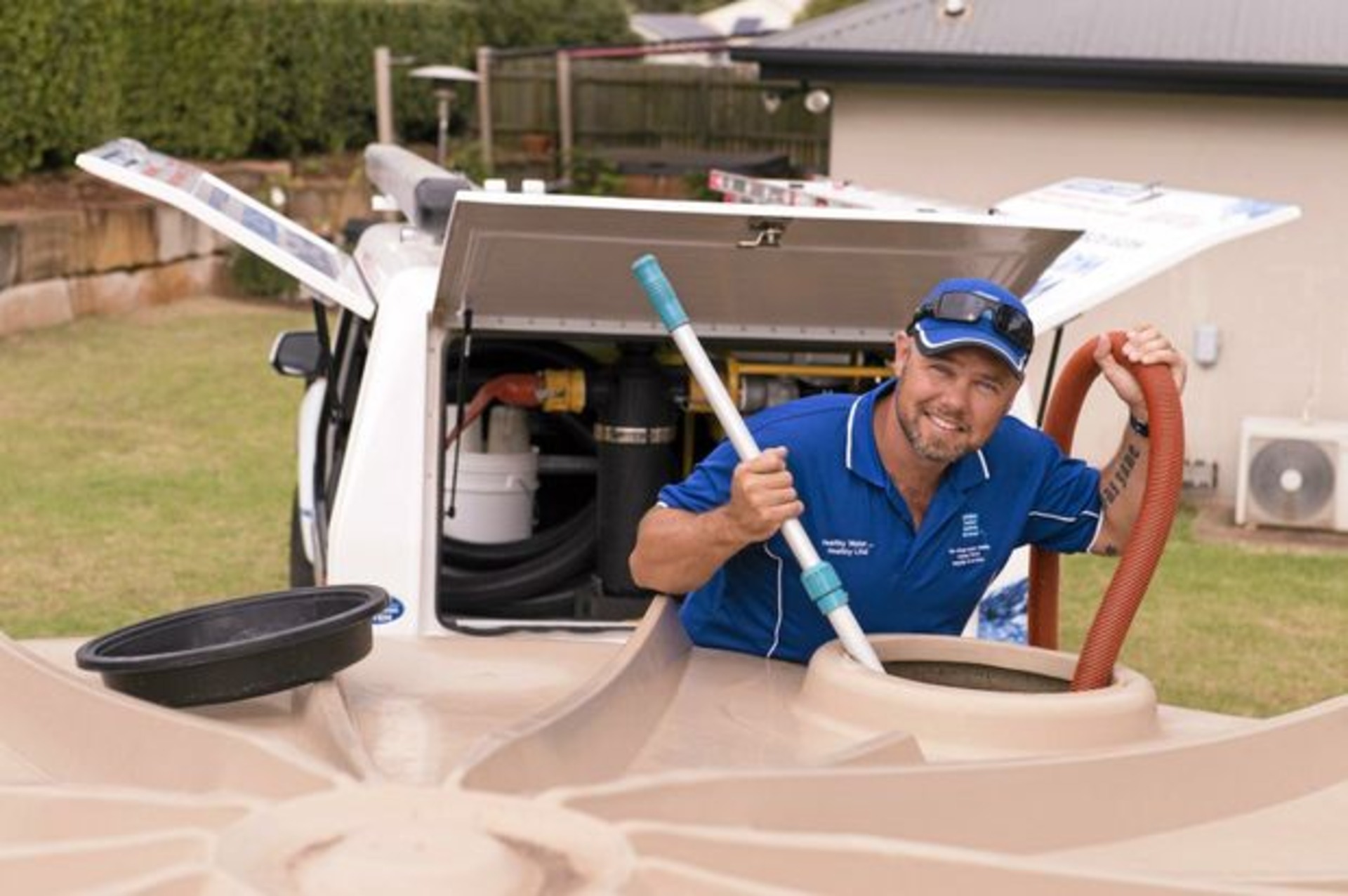
There is no single cleaning interval that suits every rainwater tank. The right timing depends on the roof and gutters, inlet protection, surrounding trees, tank design, sediment accumulation and how the water is used. A tank should be inspected periodically and cleaned when accumulated material or system conditions justify it — not simply because a calendar date has arrived.
Why sediment collects
Rainwater can carry dust, pollen, leaf fragments, insects and fine organic material from the roof catchment. Screens and first-flush devices reduce this load but cannot remove every fine particle. Material that enters the tank gradually settles on the bottom and may form a layer of sediment.
The rate varies enormously. A shaded home surrounded by trees can behave differently from an exposed coastal roof. Two neighbouring tanks of the same size may therefore need different maintenance.
Signs it is time to investigate
These signs do not all prove that cleaning alone will solve the issue. Yellow water, for example, may involve tannins from the catchment. Low pressure may relate to clogged cartridges, pump performance or plumbing.
- Visible sediment when inspecting the tank bottom
- Debris entering from damaged or missing screens
- Changes in colour, taste or odour
- Repeatedly blocked filters or unusually short cartridge life
- Recent storm, fire, pest or contamination event
- A long or unknown maintenance history
- Water-test findings that indicate the system needs investigation
Why inspection is better than guessing
A useful assessment follows the water from roof to tap: roof condition, gutters, leaf control, first flush, inlet screening, tank interior, pump, filtration, UV and household pipework. Cleaning the tank while ignoring a damaged inlet screen or dirty catchment allows the same load to return.
Pristine's QuadClean™ approach is Inspect → Extract → Sanitise → Restore. The objective is to remove accumulated bottom material while considering the wider private-water system.
Frequently asked questions
- Can a tank be cleaned while water remains in it?
- The method depends on access, tank construction, stored volume and site conditions. A technician should assess the safest and most practical approach.
- Does clear water mean the tank is clean?
- No. Fine material can settle below the outlet and may not be obvious at the tap. Clear appearance also cannot confirm microbiological quality.
- Should I test the water after cleaning?
- Testing can be valuable when water is used for drinking, when contamination is suspected, or when you want evidence about selected parameters. The appropriate sampling time depends on the purpose of the test.